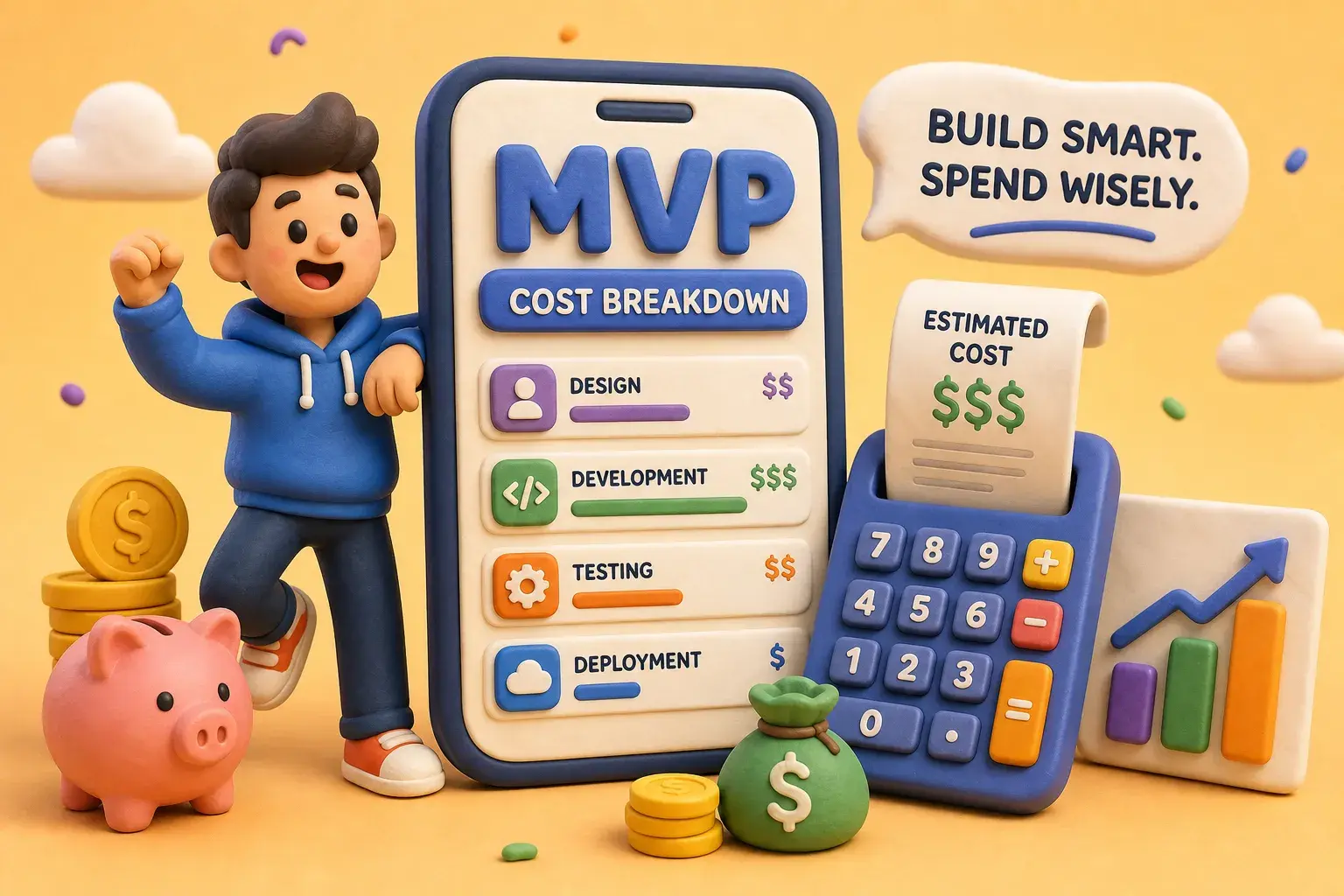
Founders routinely receive quotes ranging from £8,000 to £250,000 for what sounds like the same product. That range is not a scam or a negotiating tactic; it reflects genuinely different assumptions about scope, platform, team model, and complexity. The frustrating part is that most of those assumptions go unstated, leaving you with no reliable way to evaluate whether a quote is reasonable or wildly off. This MVP app development cost breakdown for founders in 2026 maps those assumptions to real numbers so you can build a defensible budget before a single line of code is written.
James Levine Digital offers a free app costing guide because this confusion causes founders to either underfund their build and run out of runway, or over-commit to a large agency contract before they understand what they are actually buying. What follows is a detailed cost framework that works regardless of whether you build with a local agency, a nearshore team, or a freelancer network.
What actually drives your MVP cost
Four variables control what an MVP costs: feature scope, platform choice, the complexity of each feature, and the team model used to build it. Scope is the single biggest controllable lever, and it is the one most founders underestimate. A founder who can clearly define the feature set before approaching developers will always receive a more accurate quote than one who hands over a vague idea and expects the supplier to fill in the gaps.
The difference matters more than most people realise. A simple web app with authentication and a dashboard is not the same job as a cross-platform mobile app with payments, push notifications, and an admin portal, even if both are described as an "MVP." Typical MVP builds range from roughly 300 to 900 hours depending on scope, and that gap explains most of the variation you see in quotes.
Platform choice multiplies the overall cost in a predictable way. Native iOS and Android builds cost more than a cross-platform approach using React Native or Flutter, and both cost more than a web app. Web MVPs are typically the lowest-cost starting point because there is a single codebase and no app store submission overhead. Mobile builds add device testing, platform-specific UX requirements, and Apple/Google review cycles. If you do not have direct evidence of mobile-specific user demand, default to web first. You can always build native mobile in phase two once you have validated the core product.
Realistic MVP app development cost breakdown for founders in 2026
The three complexity tiers are best understood through concrete feature descriptions rather than abstract labels. A simple MVP covers authentication, a dashboard, basic data management, and email notifications. In the UK, this sits in the £10,000 to £30,000 range for web. A medium MVP adds payments, third-party integrations, role-based permissions, reporting, and moderate admin tooling, which puts it in the £30,000 to £80,000 range. A complex MVP, one that includes AI features, multi-platform delivery, marketplace logic, or compliance requirements, typically runs from £80,000 to £200,000 or beyond.
Custom web and mobile app development at James Levine Digital starts from £15,000 with costs agreed upfront. That reflects the realistic floor for a lean but production-ready build by a senior engineer rather than a large agency team padding hours with junior developers. It is not a budget option; it is what genuinely production-ready software costs when scope is well-defined from day one.
The team model shifts the total significantly. For the same 400-hour build, you can expect to pay:
- UK or Western European freelancers (£70 to £150/hr): roughly £28,000 to £60,000
- Nearshore Eastern European teams (£40 to £90/hr): roughly £16,000 to £36,000
- Indian development firms (£20 to £60/hr): roughly £8,000 to £24,000
The critical caveat: cheaper hourly rates do not always produce a lower total cost. Management overhead, revision cycles, and communication friction can consume the savings entirely. A senior-led, well-scoped build frequently costs less overall than a junior team working from a vague brief, regardless of geography.
Where the money actually goes: an itemised budget breakdown
A typical MVP budget breaks down into eight categories. Understanding this split is central to any honest MVP app development cost breakdown for founders:
- Discovery: 5 to 10%
- UI/UX design: 10 to 15%
- Frontend development: 15 to 20%
- Backend development: 20 to 30%
- QA and testing: 10 to 15%
- DevOps and infrastructure setup: 3 to 8%
- Project management: 8 to 12%
- Licences, third-party tools, and contingency: 2 to 8%
Backend commands the largest single share because it contains the business logic, APIs, database architecture, and all third-party integrations.
Discovery is not a formality. It is where scope is locked down and where the most expensive mistakes are avoided. Founders who skip it to save money almost always spend more correcting misaligned assumptions mid-build than the discovery phase would have cost. A common example: assuming users want a native mobile app when web would have served the hypothesis equally well.
Translating these percentages into concrete figures for a £50,000 build gives you a useful reference point. The approximate midpoints by category are: £2,500 to £5,000 on discovery, £5,000 to £7,500 on UI/UX, £7,500 to £10,000 on frontend, £10,000 to £15,000 on backend, £5,000 to £7,500 on QA, £1,500 to £4,000 on DevOps, £4,000 to £6,000 on project management, and £1,000 to £4,000 on tools and contingency. Use these ranges to interrogate any quote you receive. If a supplier is allocating almost nothing to discovery or QA, that is a scope and quality risk being hidden from you, not a genuine saving being passed on.
Discovery costs
Even at the lower end of the percentage range, discovery pays for itself many times over. A structured scoping session identifies conflicting assumptions, surfaces integration dependencies, and produces the brief that underpins a reliable fixed-price quote.
Backend and infrastructure split
Backend and DevOps together account for up to 38% of a typical build budget. This is where architectural decisions, cloud provider, database choice, API design, create either a scalable foundation or expensive technical debt within months of launch.
The AI and compliance cost premium founders underestimate
AI features are not a drop-in addition. Integrating a GenAI capability, such as an LLM-powered assistant, a recommendation engine, or a document processing feature, typically adds 15 to 30 percent to the development budget over an equivalent non-AI MVP. The cost of MVP with AI features at a production-ready standard, including data readiness, guardrails, evaluation pipelines, and fallback logic, typically sits in the £12,000 to £35,000 additional range depending on complexity.
The ongoing inference cost surprises most founders. API usage, vector database hosting, and monitoring infrastructure can run £800 to £4,000 per month once user volumes climb, even at MVP scale. At the upper end, that figure reflects high-volume LLM API calls and dedicated vector database hosting rather than a simple single-model integration. Budget for this before launch, not after the first invoice arrives.
Founders building in fintech, health tech, legal, or childcare face an additional compliance layer that does not appear in generic MVP cost guides. GDPR-compliant data architecture, penetration testing, security audits, and sector-specific certifications are pre-conditions for launch, not optional extras. Based on typical costs for penetration testing, legal review, and basic audit work in the UK, budget an additional £5,000 to £20,000 depending on your regulatory environment, and factor in legal review of your privacy policy and terms before you go live. Skipping this creates liability that no amount of post-launch patching fully resolves.
Post-launch costs that quietly balloon your budget
Once an MVP is live, the build cost is not the end of the financial commitment. Industry planning guidance commonly cites 15 to 25 percent of the original build cost per year for maintenance, security patches, dependency updates, and minor feature iterations. On a £60,000 build, that is £9,000 to £15,000 annually just to keep the product current and secure. Hosting and infrastructure for an early-stage app typically runs £50 to £500 per month, and monitoring, error tracking, and product analytics tools add another £100 to £400 per month.
A technically functional MVP that nobody knows about achieves nothing. Budget a realistic customer acquisition spend alongside the build: even a modest seed-stage effort requires £1,500 to £5,000 per month to test channels meaningfully. The post-launch iteration budget is equally important. Real users will surface usability problems and missing features within the first four weeks of launch. Reserving 10 to 15 percent of the original build budget for a post-launch iteration sprint is not pessimism; it is standard practice.
How to scope your MVP to hit your target budget
The most reliable way to control minimum viable product pricing is to ruthlessly separate must-have features from nice-to-have ones before development begins. A useful framing: identify the single user action that, if completed successfully, proves the core hypothesis of your product. Everything that does not directly support that action is a candidate for phase two. Removing one medium-complexity feature, broadly, a feature requiring its own data model, a third-party integration, or non-trivial conditional logic, from scope can reduce a build by £8,000 to £20,000 in effort terms. Adding a feature back in post-launch is far cheaper than building it speculatively upfront and discovering it is not needed.
Variable quotes and open-ended time-and-materials contracts create financial risk for founders. A fixed-price quote requires a well-defined scope, which is exactly why a structured scoping process exists. The Impact Sprint offered by James Levine Digital is designed to identify the highest-value outcome before any code is written, producing a clear brief that supports an accurate, fixed price. There are no ambiguous line items and no scope creep surprises mid-project.
The free app costing guide available on the James Levine Digital website gives founders a line-item framework to benchmark any quote they receive, whether from James Levine Digital or any other supplier. Using it before approaching suppliers means you walk into that conversation with enough context to evaluate what you are being told, rather than relying on the person quoting you to explain whether their price is fair.
Turn your budget estimate into a real build plan
The full MVP app development cost breakdown for founders in 2026 comes down to five things: scope, platform, complexity, team model, and the ongoing costs that follow launch. The ranges are real, the cost drivers are learnable, and the gap between a £20,000 web app and a £150,000 AI-native platform is almost entirely explained by scope decisions made before a single sprint begins.
Founders who do their scoping work upfront, understand the line-item breakdown, and demand a fixed-price commitment from their supplier are in a fundamentally stronger position than those who start with a vague idea and hope the quotes make sense. The numbers in this article give you the framework to get there.
Download the free app costing guide on the James Levine Digital website as your next step. If you are ready to turn your MVP budget breakdown into a real build plan with a fixed price and a clear scope, book a scoping conversation with James Levine Digital and get a clear path forward.