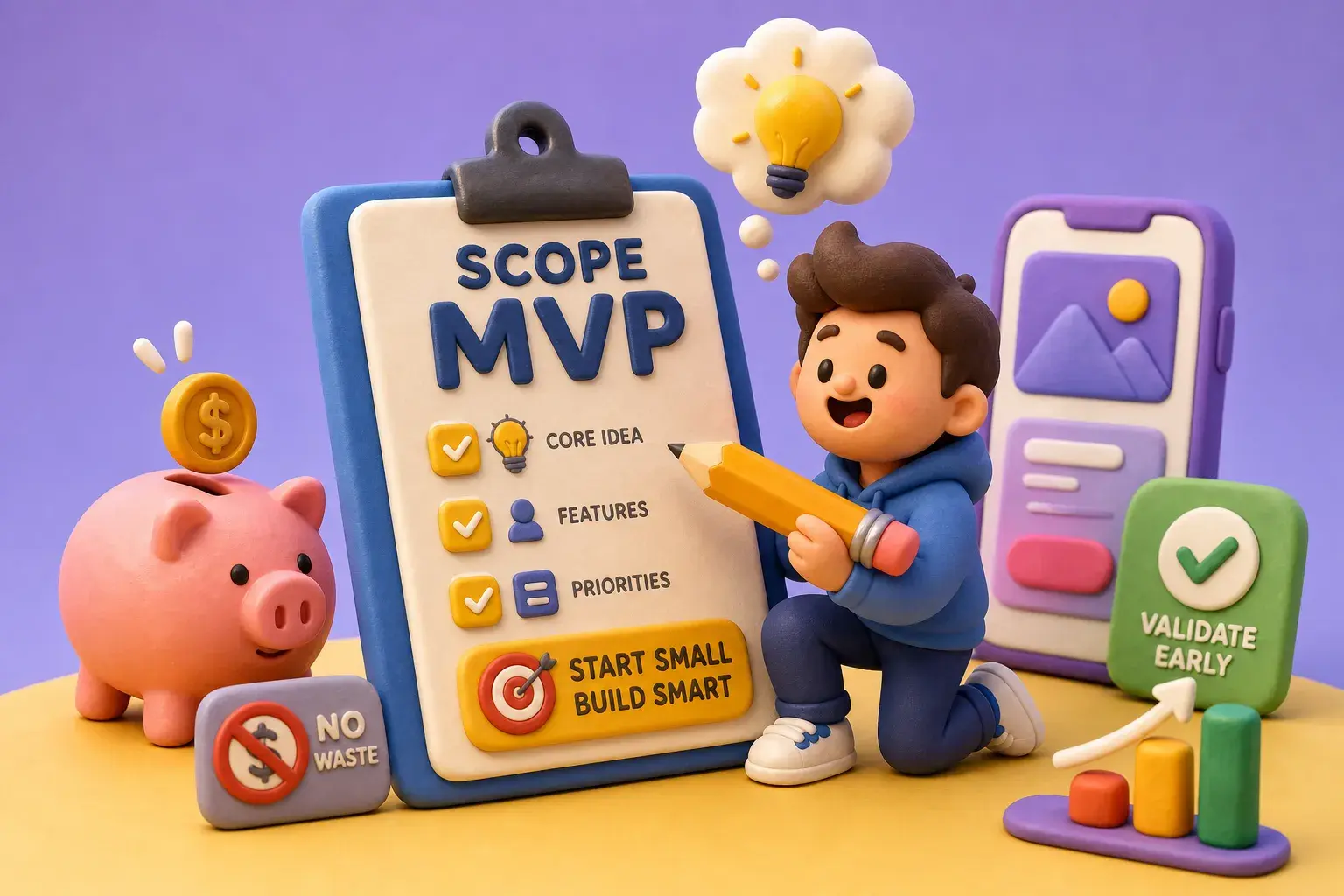
If you want to know how to scope an MVP app before spending money, start here: the single most expensive mistake founders make is commissioning development before they've properly defined what they're building and why. Founders frequently arrive at a developer's inbox with a sprawling list of features, no clear problem statement, and a budget that evaporates before the product is usable. The result is an app that technically works but solves the wrong problem, or a version one that's substantially overbuilt.
This guide walks through the full MVP scoping process: from writing a tight problem statement to choosing which features belong in version one, producing a brief a developer can actually quote from, validating demand before a single line of code is written, and arriving at a realistic budget range. By the time you finish reading, you'll have everything you need to commission development with confidence, knowing you're building the right thing at the right scale. It's the same thinking applied before any development engagement begins at James Levine Digital.
1. Define the problem before you touch a feature list
Many founders skip this step entirely and jump straight to features. The problem with that approach is straightforward: a vague problem produces a vague product. You end up building a sprawling list of functionality that individually makes sense but collectively doesn't solve anything well enough to matter.
A strong problem statement follows a simple format: identify who the user is, what they are currently unable to do, and what the cost of that failure is. A concrete example makes this tangible. "Freelance project managers spend three or more hours a week chasing overdue invoices manually, because their accounting tools don't send automatic follow-up reminders." That one sentence contains the user, the broken workflow, the time cost, and the gap in current solutions. It also immediately suggests what the MVP needs to do.
What a strong problem statement does to your feature list
The discipline of writing a problem statement has a useful side effect: it becomes a filter for every feature idea you generate. If a feature doesn't directly address the stated problem, it doesn't belong in the MVP. This single exercise typically cuts early-stage feature lists down substantially before any framework is applied.
The most clarifying question you can ask at this stage is: what is the most valuable outcome for the first user? Answering that forces you to anchor the MVP to one measurable result, rather than a collection of hoped-for functionality. It also prevents the common trap of building a platform when a focused tool would have done the job at a fraction of the cost.
2. Prioritise features using a framework, not a gut feeling
Once the problem is clearly defined, every feature idea needs to be stress-tested against it. Building a list based on enthusiasm rather than necessity is how MVPs become overbuilt and over-budget. A lightweight framework turns that list into a genuine scope with defensible decisions behind it.
How MoSCoW works in practice
MoSCoW is the most practical framework for early-stage scoping. It splits every feature into four categories: Must-have, Should-have, Could-have, and Won't-have. Must-haves are non-negotiable: without them, the MVP doesn't function or fails to test the core value proposition. Should-haves are important but can be deferred without killing the product. Could-haves are nice additions if time and budget allow. Won't-haves are explicitly excluded from this release.
Applied to a simple example: user authentication is a Must, email notifications are a Should, social sharing is a Could, and an admin analytics dashboard is a Won't. The critical discipline is keeping the Must-have list as short as possible. Most MVPs are overbuilt because founders treat Should-haves as Musts. If you can still test the core problem without a feature, it does not belong in the Must column.
When RICE scoring helps you break a tie
When two features both feel essential and you need a more objective way to compare them, RICE scoring helps. RICE stands for Reach, Impact, Confidence, and Effort. You score each feature across those four dimensions and divide the first three by effort to get a priority score. The goal isn't a perfect spreadsheet. It's to make trade-offs visible and explicit rather than driven by whoever speaks loudest in the room.
A practical rule: if you find yourself with more than eight or ten Must-have candidates, you haven't been strict enough with the MoSCoW pass. Go back through the list and ask, for each one, whether the MVP can still validate the core problem without it. Most of the time, the answer is yes.
3. Write a one-page brief that a developer can actually quote from
A well-scoped idea is only useful if it's documented clearly. A one-page brief gives a developer, designer, or technical advisor something concrete to work from, without ballooning into a forty-page specification document that nobody reads in full. The goal is clarity, not comprehensiveness.
The five elements every MVP brief needs
A solid MVP brief covers five things: the problem statement, the target user, the Must-have features written as user stories, the success metric for the MVP, and any known technical constraints or integrations. User stories follow a simple format: "As a [user type], I want to [do X] so that [outcome Y]." They expose ambiguity early and keep functionality tied to real user needs rather than abstract ideas.
The brief also forces the founder to confront gaps in their own thinking before those gaps cost money. If you can't write a clear user story for a feature, that's a signal the feature isn't fully formed yet. It's far cheaper to discover that at the brief-writing stage than mid-build.
How a structured scoping process helps non-technical founders
For founders who want to work through this with senior technical input, the Impact Sprint at James Levine Digital is built precisely for this stage. It's a focused scoping engagement that guides non-technical founders through problem definition, feature prioritisation, and brief-writing, designed to surface the clearest possible picture of what's worth building before any development budget is committed. The output is a scope document ready for a developer to quote from, rather than a vague brief that generates wildly different estimates.
4. Validate your assumptions before any money changes hands
Having a well-written scope document doesn't mean your assumptions are correct. Before you commission a developer, you need evidence that real people have the problem you've described and would actually use and pay for a solution. Many validation methods cost almost nothing and can be completed in a matter of days, particularly landing pages, clickable prototypes, and concierge tests.
The cheapest ways to test whether your idea has legs
Three low-cost methods stand out at this stage.
The first is a landing page smoke test: build a simple page with a clear value proposition and a "join the waitlist" call to action, drive a small amount of targeted traffic through paid ads or relevant online communities, and measure sign-up conversion. This is achievable in days for roughly £150 or less and gives you real behavioural data rather than polite opinions. Consider low-code or no-code tools to build the page quickly and keep costs down.
The second is a clickable prototype: use a free tool such as Figma to simulate the core user flow and test whether people understand the product before any backend work begins.
The third is a concierge MVP: manually deliver the outcome to a handful of early users before building anything, validating whether people will actually use and pay for the result.
A sensible sequence is to start with customer interviews and a landing page, move to a prototype if genuine interest holds, and attempt a concierge MVP only if both earlier tests pass. Each stage is a gate, not a formality.
The metrics that tell you it's worth building
Waitlist or demo conversion rate shows whether the offer creates real intent rather than casual curiosity. Activation rate during prototype testing is another strong signal, anything above 60% suggests users can understand and complete the core action. The most meaningful indicator, however, is evidence of willingness to pay: pricing page clicks, pre-orders, or direct requests for access carry far more weight than free sign-ups alone.
Further positive signals include 30-day retention above 30% and paid conversion above 5%. Validation isn't about achieving perfection before you build: it's about reducing the risk of committing a significant budget to the wrong thing at the wrong time.
5. Estimate what this will cost (and build in a realistic contingency)
Once the scope is tight and the core assumptions are validated, a rough cost estimate lets you decide whether to invest in development at all. UK app development costs vary considerably depending on team size, complexity, and how clearly the brief is written. There are, however, sensible planning bands that give founders a defensible starting figure.
UK cost bands for simple, medium, and complex MVPs
A simple MVP, covering a single user type with basic functionality and no complex integrations, typically falls in the range of £9,000 to £36,000 all-in including contingency.
A medium MVP, covering multiple user roles, payment processing, third-party integrations, and both mobile and web delivery, sits in the £29,000 to £96,000 range.
A complex MVP, where you're adding AI features, compliance requirements, real-time functionality, or multi-platform delivery, starts at £69,000 and can exceed £240,000.
These are planning ranges, not quotes. Actual costs depend entirely on the specific brief and the team you engage. For a full line-item view of where the money goes, see the MVP app development cost breakdown for founders.
What drives costs up and how scoping keeps them down
The single most expensive cost driver in app development isn't technical complexity: it's unclear requirements. Ambiguous briefs generate scope changes mid-build, and mid-build changes are far more expensive than getting the scope right before development starts. Other significant drivers include untested third-party integrations, regulatory or compliance requirements, and features that weren't explicitly agreed before the first sprint.
A tight, written scope with clear user stories and explicit exclusions is the most effective cost-control tool available before development begins. As standard practice, build in a 15 to 20% contingency on top of your estimated build cost. If your product is integration-heavy or operates in a regulated sector, plan for 20 to 30% instead. That buffer exists to absorb what you don't yet know, not to cover scope that was never defined.
Put it all together before you speak to a developer
Scoping an MVP app before spending money comes down to five outputs: a clear problem statement, a prioritised feature list using MoSCoW, a one-page brief with user stories and a defined success metric, at least one completed low-cost validation test, and a realistic budget range with contingency built in. Together, these mean you're not walking into a developer conversation with a wish list and a vague budget, you're arriving with a brief, evidence, and a minimum viable product scope that reflects what you actually need built.
For founders who want to work through this with senior technical input, the Impact Sprint at James Levine Digital is built for exactly this stage. It's a focused scoping engagement designed to surface what's worth building and what it should cost before any development spend is committed. If you have an idea but aren't yet sure what to build first, that's the right place to start.