

Problem
Reach plc publishes the Daily Mirror, one of the UK's biggest-selling national newspapers. Print circulation was falling year on year, but a large, loyal, paying audience still wanted the paper: the front page, the layout, the crossword on page 42. The business goal was retention: give that audience a digital product they'd pay for and stay with, before print decline took them elsewhere.
The brief was a digital edition: download the day's newspaper as a faithful replica, read it fully offline, and turn the pages the way you would the physical paper, not a reflowed article feed the audience didn't want.
Process
The early product conversation assumed a modern article feed. Talking through what this specific reader actually valued, we made the deciding call: fidelity to the printed page beats a "better" reflowed experience for this audience. Chasing responsive text would have built the wrong product for the people most likely to pay. So the engineering effort went where it mattered: large binary downloads, offline reliability, and a demanding mass-market audience.
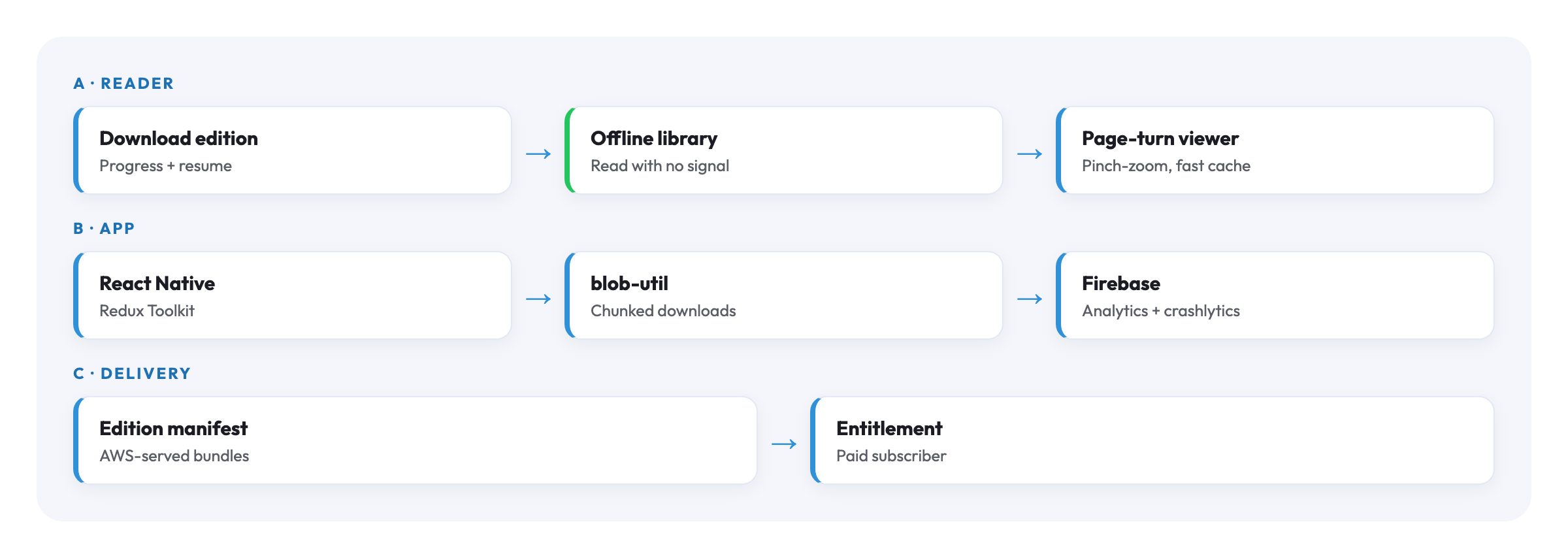
- Edition download and offline store. Each daily edition is a large bundle of high-resolution pages.
react-native-blob-utilstreamed downloads to disk with progress UI, resumable on flaky connections, plus an on-device library so readers could keep back-issues or delete them to reclaim space. - Page-turn reading experience. A fast, gesture-driven page viewer with pinch-to-zoom on dense layouts, with aggressive image caching so turning pages felt instant once an edition was downloaded.
- State with Redux Toolkit. Download status, library contents, entitlement and reading position lived in one store so the UI stayed consistent online, mid-download, or fully offline.
- Analytics and stability. Firebase Analytics and Crashlytics gave editorial and product teams real usage data and crash-free-session tracking across every Android device imaginable.
Outcome
The Daily Mirror digital edition gave the paper's loyal readers a genuinely offline-first product: download in the morning, read anywhere, even underground with no signal, and a reason to keep paying as print declined. It was built as a config-driven platform, so the same codebase could carry additional mastheads by switching branding and feeds rather than commissioning a new app each time.
"It gave our most loyal readers exactly the paper they wanted, on their phone. That's the audience we most needed to keep."
Product lead, Reach
Architecture
For engineersTechnical Deep DiveExpand
One codebase, many mastheads
The edition was built so a masthead is a configuration, not a fork. Build-time configuration (react-native-config) selected the title: app name, theme colours, icon set, splash animation, and content endpoint. This kept feature work in a single place, so a download-resume fix would ship to every title at once, while each masthead kept its own identity in the store and on the home screen.
Offline as the default, not a fallback
Most news apps treat offline as a degraded state. For a digital edition it's the primary one: the promise is "download it and read it on the Underground." So the data model was inverted: the on-device library was the source of truth for reading, and network activity was limited to fetching the edition manifest and pulling page bundles. react-native-blob-util handled the heavy lifting: chunked writes to the filesystem, progress events wired into Redux, and cleanup of partial downloads after an interrupted session.
Trade-offs
- Storage vs convenience. Keeping many back-issues on device is generous but eats space. We surfaced per-edition size and a one-tap delete rather than silently evicting, because readers noticed and complained when editions vanished.
- Replica vs reflow. A page-faithful replica can't reflow text for small screens, so we invested in a smooth zoom/pan viewer instead. For this audience, fidelity to the print layout beat responsive text.